Posts

What did they wear? Links on Clothing in RPGs
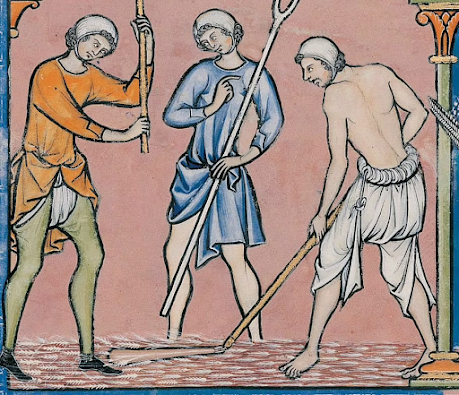
Image
Peasants threshing wheat in breeches and tunics (from the  Maciejowski Bible) https://www.medievalists.net/2018/06/underwear-in-the-middle-ages/ I was inspired for this post reading  A Collection of Unmitigated Pedantry on Clothes: How Did They Make It?  . Brett Devereaux goes into depth in a four-part series on how fabrics were made and who made them. For anyone interested in realistic worldbuilding or history more generally, the blog is invaluable.                                                                                       https://www.publicecology.de/journal/good-old-linen Given that most RPG clothing conversation consists of either a series of uniforms (priestly robes, noble finery) or purely as a determinant of armor cla...

Book Review: Why Liberalism Failed

I read this book as a part of a book club and I learned from it. Deneen points out many of modern society's failures, in some cases like hitting the broad side of a barn (social inequality, feelings of political powerlessness), in other cases more precisely ('strip mining' of talent from small communities, loss of local institutions and culture, a lack of connection between workers and the product of their labor). Deenen's primary claim is that Liberalism sowed the seeds of modern discord through it's commitment to individual choice at the expense of more communal goals. Deneen's primary claim is that Liberalism as it was conceived and implemented from the 17th C. onwards redefined the Western concept of Liberty and the nature of man. In Western classical and Christian traditions, Liberty was understood to mean disciplined self-rule and freedom from oppression. Liberalism reconceptualized liberty to mean a capacity for individual voluntary choice. This was roote...

2020 Books

During lockdown I started reading again. Initially via audiobook while running, then later also using physical books and ebooks on my commute. Here are my thoughts on some of those books. Fire and Blood by George R. R. Martin (audiobook) This was in many ways a perfect lockdown book. Long, far from reality, emotionally distanced. Very enjoyable in that it presented dozens if hundreds of characters and paid them off one after another with enough detail that things didn't feel forced but not so much detail that everything couldn't be pieced back together into a single long narrative. A great worldbuilder's sourcebook, this felt like the kind of sweeping real world history told from a single learned person's viewpoint. I probably enjoyed this more than I would the main series as it didn't dwell overlong on any one character but packed all of the romance, drama and treachery of the series. Some less charitable would call that emotional removal dry. Warren Buffett and t...

Thoughts On Ars Magica 5th Edition

I was inspired by some of Justin Alexander's posts on Ars Magica to check it out.  This isn't a full review but a collection of observations. For a more thorough review, look here . The system does several things that I liked. The focus on building a covenant essentially places the players into domain-level play from the very beginning, foregrounding issues of local politics. Also, there is a strong influence on long-term character development through what D&D would characterize as downtime actions.  The systems for things like training, teaching, writing books and developing spells are quite robust and as such play can be easily extended over seasons. This necessarily requires some abstraction, but the benefit is that character arcs are longer and the system supports stories with long-term payoffs. The magic system is central to the entire game and as such it is very detailed, certainly more so than most games I've played or run. It's difficult for me to determine...

On the Difficulty Problem of Magic

Lately I have been thinking a lot about how to implement a magic system in my tabletop roleplaying games. I would like to create something rather long-lasting in a persistent world where players might be able to play over generations and see the effects of their actions.  As such, I want a system with rules that I can reference to consistently adjudicate actions. I also want to treat magic as a kind technology that can be developed over time to create emergent effects on the world. This post from the Crossing the 'Verse blog represents an attempt to codify mechanically how different types of magic might manifest. It is part of a larger, useful series attempting to reach the heart of what magic is, in-game. When considering the magic system one problem that emerges is how to explain why some people use magic and others don't. If magic can be broadly considered a kind of technology, then why is there a class of magic users and why don't peasants employ goodberries to feed th...