Posts

Showing posts with the label worldbuilding

Paradox Interactive Worldbuilding
Image
     I have long been fascinated with the idea of domain play and games in which players can make an impact on the world, not simply act as the main characters in a movie. What happens when the movie is over? How will the characters be remembered when they are gone? Who will remember them? As a GM I hope to provide the players with an experience in meaning making that allows them to build a legacy.     In order to have a game in which it is possible for players to affect history greater detail and care are required in worldbuilding. For players to feel the weight of their actions and receive a feeling of true accomplishment, the world needs to exist in as tangible a sense as possible. This kind of a game requires not only detail, but verisimilitude and objective systems. Players need to know that their actions will succeed or fail based on the objective rules of the imagined world rather than the whims of an idle god (or GM).     I have for several yea...

RPG Worldbuilding is World Modelling

Image
       I just finished the book Energy and Civilization: A History by Vaclav Smil. It took me year to read it and it was the most informative book I've ever read. It comprehensively traces the history of energy usage throughout human history. The book also made me a much better GM. Mosts GMs are familiar with worldbuilding as the stockpiling of lore and backstory, as an exercise of mapping and building a fictional world and populating it with non-player characters and monsters and treasures with which to surprise and challenge and hopefully entertain the players. I'm not saying it isn't those things but I do think worldbuilding is something more. The RPG world is the shared fictional enviroment the GM and players inhabit together during play. In traditional play the GM makes up the facts of the world and communicates those to the players through play. Some GMs are better at communicating those details than others, some have more complex worlds some simpler, some re...

RPG Review: Worlds Without Number

Image
Worlds Without Number Kevin Crawford Sine Nomine Publishing In college I became friends with a guy named Greg whose passion was cars. He raced them, fixed them, learned all he could, spent all his money on them.  He and a number of other car people owned 1990s Honda Civics - small, low-horsepower, hatchbacks - not flashy. I asked him why and he that they were old, so easily accessible, cheap, simply constructed with plentiful spare parts for modifications. The light frame gave it spectacular performance when the engine was upgraded. Greg took me for a ride once and the performance of his modded Civic was indeed spectacular. To compare Kevin Crawford's 398-page RPG rules tome to a light-bodied racer might seem nuts, but bear with me. First, and most importantly, Worlds Without Number (WWN) is a complete game. Everything you need to play and to generate game content is inside, and it is well thought-out so that newer GMs and veterans alike should be able to benefit. As a comparison, ...

Piranesi and Mysteries in Created Worlds

Image
There is something delicious about a mystery. I won't say much about this but that it continually presents the reader with questions to ponder. The narrative is generous and consistent enough that these questions can yield significant answers. The tone of the book is contemplative and yet also somehow effusive and I can't recommend highly enough the audiobook narrated by Chiwetel Ejiofor.  The rest of this post contains light spoilers, so go and listen to this short novel before reading on.    Piranesi's title character inhabits a house that evokes the 18th century Italian Giovanni Battista Piranesi's series of Imaginary Prisons (pictured above). Susanna Clarke slowly feeds the reader information that is remarkably clear and consistent, allowing her audience to gradually move from guessing at mysteries to a series of revelations.  At one point in the story Clarke references the wisdom of the ancients. The idea is that certain people operate using a kind of pre-ratio...

WEIRD Worldbuilding

Image
WEIRD Worldbuilding   The Ebstorf Map This post is refers to the book The WEIRDest People in the World by Joseph Heinrich, which I have reviewed here . The WEIRDest People in the World isn't specifically about tabletop RPGs or worldbuilding. It is about cultural evolution and how certain packages of cultural norms, institutions and psychology emerged and developed over time into Western, educated, industrialized, rich and democratic societies today. The book does spend a lot of time discussing the kinds of features that affect societies' collective psychology, institutions and ability to scale to larger populations. A big concept is the idea that different kinds of institutions are necessary to bond society together. In this post I will try to lay out what I have gleaned and how it can be used by prospective worldbuilders.  Laying out the building blocks: Clans & Family The vast majority of human societies historically have been based on kinship (familial) ties. There is a...

What did they wear? Links on Clothing in RPGs

Image
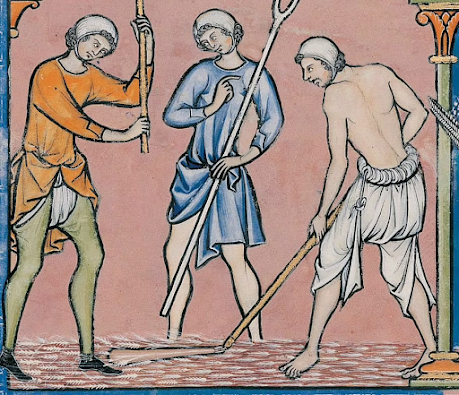
Peasants threshing wheat in breeches and tunics (from the  Maciejowski Bible) https://www.medievalists.net/2018/06/underwear-in-the-middle-ages/ I was inspired for this post reading  A Collection of Unmitigated Pedantry on Clothes: How Did They Make It?  . Brett Devereaux goes into depth in a four-part series on how fabrics were made and who made them. For anyone interested in realistic worldbuilding or history more generally, the blog is invaluable.                                                                                       https://www.publicecology.de/journal/good-old-linen Given that most RPG clothing conversation consists of either a series of uniforms (priestly robes, noble finery) or purely as a determinant of armor cla...

On the Difficulty Problem of Magic

Lately I have been thinking a lot about how to implement a magic system in my tabletop roleplaying games. I would like to create something rather long-lasting in a persistent world where players might be able to play over generations and see the effects of their actions.  As such, I want a system with rules that I can reference to consistently adjudicate actions. I also want to treat magic as a kind technology that can be developed over time to create emergent effects on the world. This post from the Crossing the 'Verse blog represents an attempt to codify mechanically how different types of magic might manifest. It is part of a larger, useful series attempting to reach the heart of what magic is, in-game. When considering the magic system one problem that emerges is how to explain why some people use magic and others don't. If magic can be broadly considered a kind of technology, then why is there a class of magic users and why don't peasants employ goodberries to feed th...