Posts

Showing posts with the label RPGs

Paradox Interactive Worldbuilding
Image
     I have long been fascinated with the idea of domain play and games in which players can make an impact on the world, not simply act as the main characters in a movie. What happens when the movie is over? How will the characters be remembered when they are gone? Who will remember them? As a GM I hope to provide the players with an experience in meaning making that allows them to build a legacy.     In order to have a game in which it is possible for players to affect history greater detail and care are required in worldbuilding. For players to feel the weight of their actions and receive a feeling of true accomplishment, the world needs to exist in as tangible a sense as possible. This kind of a game requires not only detail, but verisimilitude and objective systems. Players need to know that their actions will succeed or fail based on the objective rules of the imagined world rather than the whims of an idle god (or GM).     I have for several yea...

RPG Worldbuilding is World Modelling

Image
       I just finished the book Energy and Civilization: A History by Vaclav Smil. It took me year to read it and it was the most informative book I've ever read. It comprehensively traces the history of energy usage throughout human history. The book also made me a much better GM. Mosts GMs are familiar with worldbuilding as the stockpiling of lore and backstory, as an exercise of mapping and building a fictional world and populating it with non-player characters and monsters and treasures with which to surprise and challenge and hopefully entertain the players. I'm not saying it isn't those things but I do think worldbuilding is something more. The RPG world is the shared fictional enviroment the GM and players inhabit together during play. In traditional play the GM makes up the facts of the world and communicates those to the players through play. Some GMs are better at communicating those details than others, some have more complex worlds some simpler, some re...

Bridging the Player Information Gap

Image
Space Shuttle Endeavor Recently my friend Vishal asked me a question about my post on Philosophers, Heretics and Madmen :  I'd be interested in your take on how a GM can not just recreate that experience [of being transported to another place and culture] but also bridge the gap between the players' culture and effectively interacting with an older one.  I've had so many examples running games when players did not know what to make of an alien culture. This is a great question. Coming from the most experienced GM I know, it seems likely to be a topic worth exploring further. It reminds me of a concept, the  player information gap , first brought to my attention by Shea Valentine at the excellent Living Myth RPG blog. In the post Fixing Social Mechanics and the Player Information Gap , Valentine defines player information gap as "the disparity between what a player knows and what the player's character knows." Player information gaps can be an issue when playe...

Social Interaction 2: Examples from D&D, Naturalistic Interaction Mechanics, Ability Checks & Reaction Rolls

Image
  The previous post about social interaction  explored the different areas that social rules should cover. A relatively complete system should help resolve social situations when there is conflict and uncertainty, specifically: persuading others and resisting attempts at persuasion lying, recognizing falsehoods (related: seeking secret information, hiding information) maintaining relationships This article will look at different social mechanics in published games and see how (or whether) they represent these concepts. We will also look at how players can affect outcomes and what GMs are directed to consider when adjudicating interactions. Social Interaction Rules in D&D We will start with the big one, looking a social mechanics from the current edition, D&D 5E, and then look at variations from earlier iterations of the game. On page 185 in the 5th Edition Player's Handbook under social interaction the section divides interaction into roleplaying and ability checks. Un...

Social Interaction 1: What do social interaction mechanics need to do?

Image
Camille Silvy In the last post I wrote about how social interaction and modelling unfamiliar worldviews is at the heart of the RPG experience. On the one hand, thrusting ourselves into alien situations and on the other, interacting with other people who are products of foreign milieus can broaden our own experience. There is a degree of sleight of hand here as all RPGs are hosted in our own imaginations, but experience gained through imagination is still real experience. Non-Designed Mechanics Social interaction is an important part of RPGs but it is often underserved in terms of game mechanisms. I think that because tabletop roleplaying is fundamentally a conversation, many designers tend to assume social interaction can be handled in a naturalistic manner without dedicated mechanics. Also, fish probably don't design ttrpg mechanics for breathing underwater. In fact, those pescatory designers are often right! For most interactions players can just use their inherent conversationa...

Philosophers, Heretics and Madmen

Image
Thales of Miletus I often think of tabletop roleplaying as a form of time travel, or even better, mind travel. It is a chance to jump out of the circumstances of one's own life and look at things differently. Other media can also allow a similar escape, but the two factors that differentiate roleplaying are that players must act and make choices and they must also simulate the world inside their own brain. This feeling of freedom, of seeing things from perspectives that you might never otherwise experience is one of the great joys of the hobby for me. Recently I read that Thales of Miletus was the first recorded practitioner (and possible inventor of) deductive reasoning. I was flabbergasted. The idea that something seemingly so fundamental as rationalist reasoning simply didn't exist as recently as 2600 years ago is actually kind of astounding.  If the past is a foreign country, then the distant past is an alien world. Imagine what it would be like to interact with someone wh...

Art and Inspiration in RPGs

Image
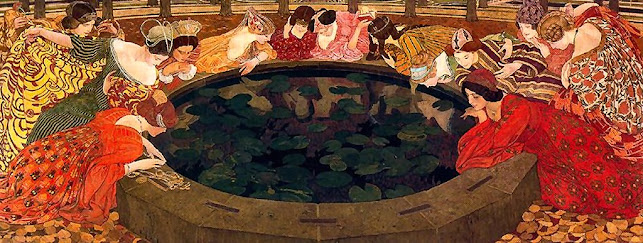
Ernest Biéler. L'eau mysterieuse, 1911 I have been looking around for resources in order to collect art and images to use as props and worldbuilding materials for tabletop games. There is no substitute for personal knowledge of art but here are a few things I've found. Ben L. at Mazirian's garden has a post about his creative process and one of thing he does for inspiration is to scour the web for artistic reference points, which he compiles into Pinterest collections on various themes. I asked Skerples at Coins and Scrolls where he finds the art posted on the blog and he mentioned ArtStation and has other Wikimedia Commons.  ArtStation is very good for all sorts of artists, particularly genre-based artwork for games. You can look at portfolios to get a sense of technique and subject matter. I'm not sure of fair use rules so I won't post anything here but the quality is excellent. Wikimedia commons  has a lot of public domain artwork and also has audio and video...